By Lokiru Samuel, African Palliative Care Association.
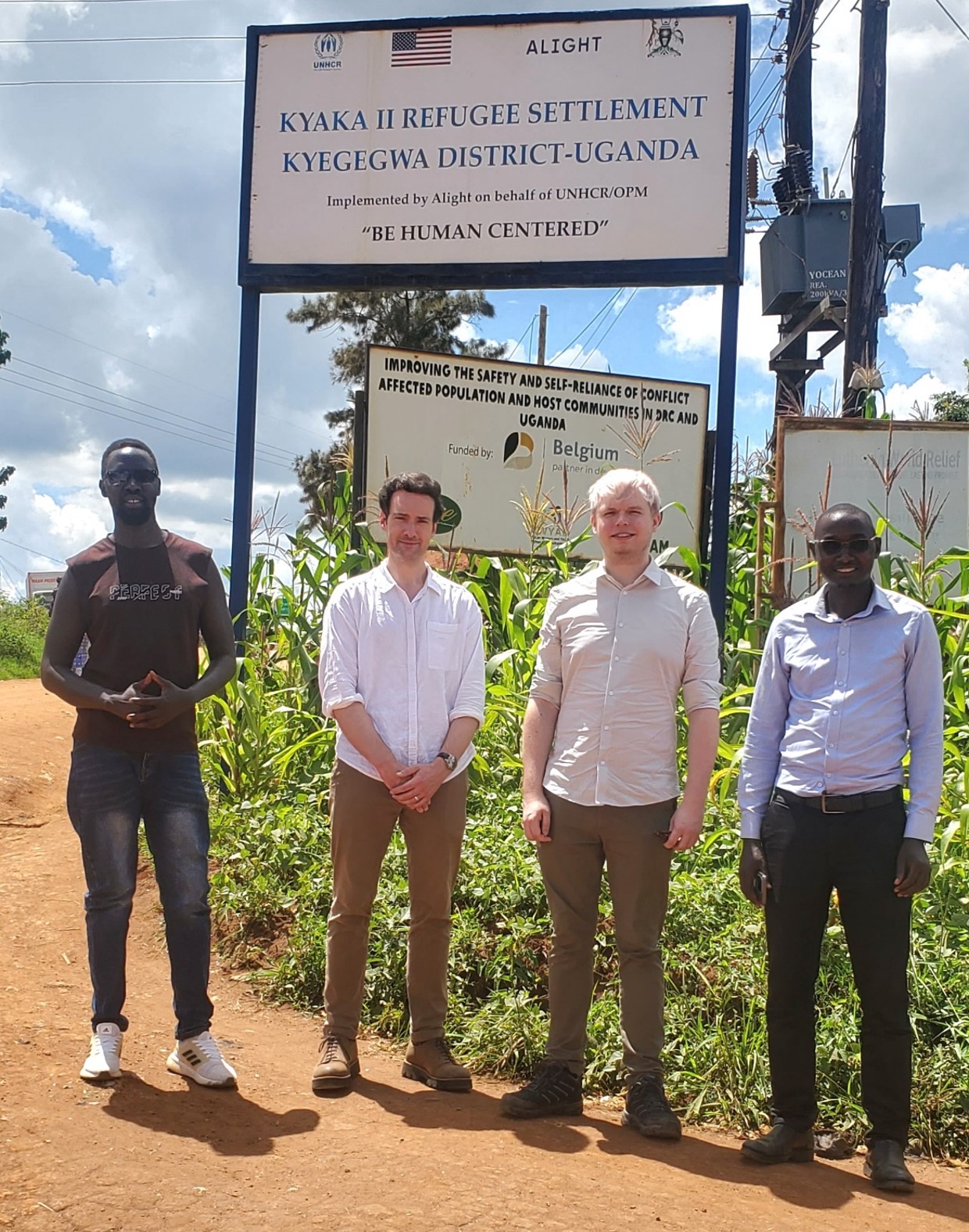
A brief pause after a long day in the field. I stand beside Professor Matthew, (his arms folded,) while Dr. Will shares the frame with Mutoto.
This is Part One of a two-part series following a joint field visit to western Uganda and engagements with the Uganda Ministry of Health. The visit brought together Professor Matthew Allsop and Dr Will Goodman from the University of Leeds, me from APCA, and the data assistant Emmanuel Mutoto, as we explored innovation, implementation, and the realities of palliative care delivery in resource-constrained settings.
We set off on Wednesday, May 6, at 4:30pm EAT from Kampala to Kyegegwa District. The journey west carried us through Mpigi, Mityana, and Mubende before reaching Kyaka II Refugee Settlement the following morning. As traffic faded into long stretches of highway, the road revealed the realities that shape healthcare access in these areas: distance, movement, and isolation. By the time we arrived, one thing was already clear: conversations about palliative care in Uganda cannot be separated from displacement and the challenge of reaching people far from major health facilities.
Our first engagement was at Bujubuli Health Centre IV, a primary healthcare facility located in the Kyaka II Refugee Settlement.
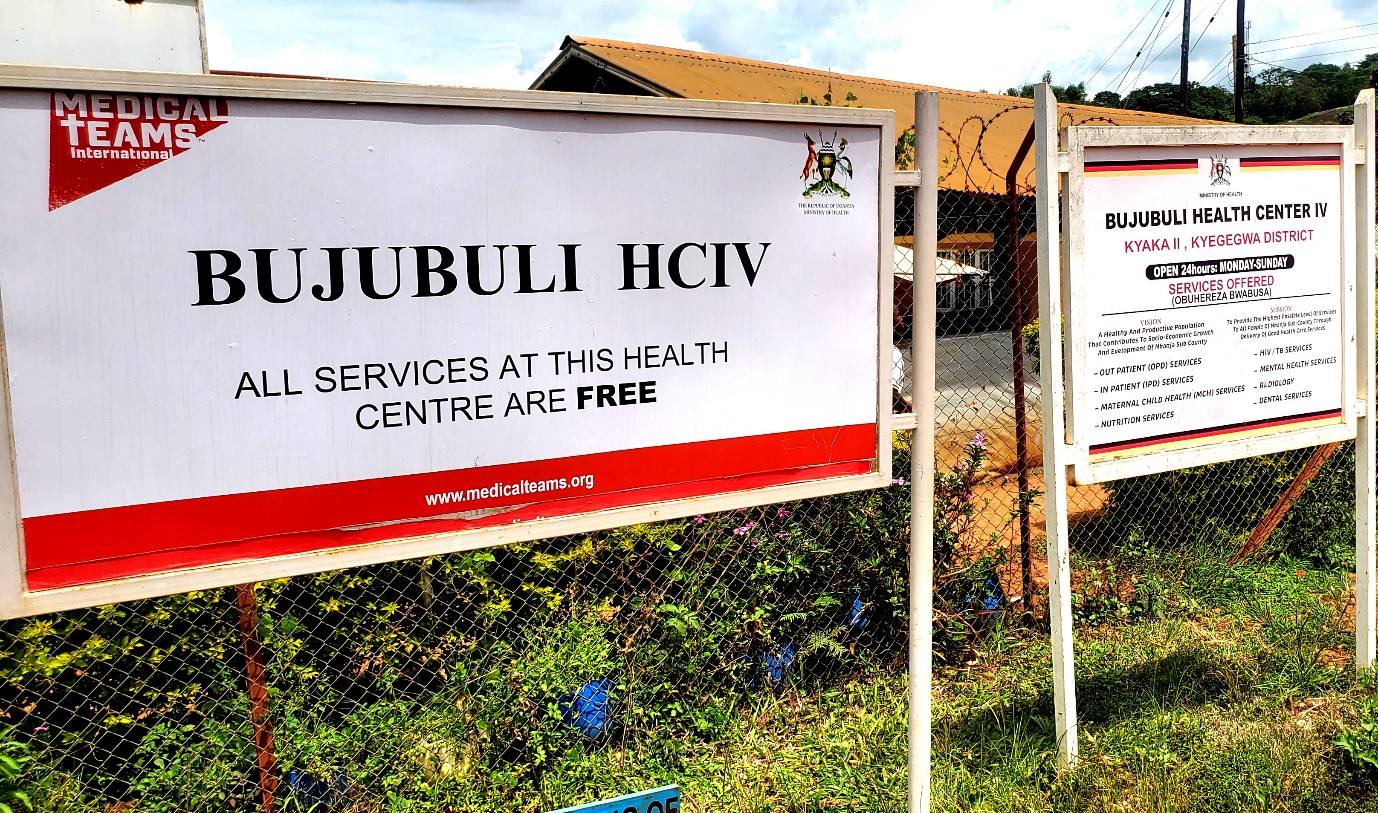
Inside, consultation rooms remained full throughout the day. Patients arrived with advanced cancer, HIV, heart failure, chronic respiratory disease, and other life-limiting conditions. Some had travelled for hours. Others had lost continuity of care during displacement.
Clinicians described the difficulty of working with limited medicines, thin staffing, and fragmented records, while still trying to respond with dignity to pain, distress, and uncertainty. Health workers repeatedly spoke about the challenge of maintaining continuity of care for patients moving between facilities, communities, and humanitarian settings. Many relied on paper records, making follow-up difficult when patients transitioned between community and facility-based care.
It is within these realities that Uganda’s evolving digital palliative care work, including the mPallCare platform, is being tested. Developed through collaboration involving the African Palliative Care Association, researchers, clinicians, and technology partners, mPallCare is designed to support holistic assessment, symptom monitoring, clinical documentation, and continuity of care across settings.
Discussions throughout the visit repeatedly returned to a central question: how do health systems better identify, document, and respond to suffering where resources remain limited?
As clinicians described the pressures shaping frontline care delivery, Professor Matthew Allsop listened closely during discussions inside the facility. Many of the issues raised reflected broader questions he has worked on for more than a decade across palliative care research and implementation in resource-constrained settings.
“Innovation in palliative care matters to me because, at its heart, palliative care is about responding to suffering,” Prof. Mathew said. “We need better, more equitable ways of reaching people who are too often left behind.”
His connection to Uganda and the African Palliative Care Association spans more than a decade. He first met Dr. Eve Namisango the current APCA Executive Director and the APCA team during a self-funded placement in Uganda, where he spent two weeks working alongside researchers and clinicians.
“What I saw, heard and felt during those weeks has stayed with me,” he recalls. “I saw extraordinary commitment in settings where need was immense, but resources, medicines, infrastructure, and workforce capacity were severely constrained.”
That experience later evolved into a long-term collaboration around research, implementation, and digital approaches aimed at strengthening continuity of care in resource-constrained settings.
“All of this only works if it serves real clinical need,” he said. “Innovation is not about technology itself. It is about practical, compassionate ways of supporting care for people with advanced illness in constrained settings.”
Across low- and middle-income countries, the demand for palliative care continues to grow. Patients with advanced illness often struggle to access consistent symptom management and coordinated follow-up. The realities observed in western Uganda reflect broader systemic
pressures across the region. Documentation burdens, weak follow-up systems, and high workloads continue to shape daily clinical decision-making.
Yet alongside these pressures, there was persistence. Clinicians continuously spoke about the need for tools that reduce fragmentation and strengthen assessment, symptom tracking, and coordination. From a research perspective, Prof. Matthew describes two linked functions of mPallCare.
“First, it supports clinical management of people with advanced illness,” he said. “Second, it generates data on symptoms and care needs in contexts where this evidence is often missing.”
He is also aware of scepticism toward digital health in constrained systems.
“I understand why digital tools raise concerns,” he said. “When systems lack medicines, staff, transport, and funding, technology can feel like a distraction.”
But he is careful not to frame digital systems as substitutes for health system investment.
“These tools must never replace essential services,” he said. “But they can help make limited resources work more effectively and more equitably.”
Within the facility, these questions were not theoretical. Health workers described tracking symptoms across multiple visits while managing heavy workloads. Others emphasised the need for assessment systems that go beyond physical pain to include psychological, social, and practical concerns.
mPallCare is designed to address part of this gap by integrating holistic assessment, symptom tracking, and clinical documentation into a single system.
“It helps ensure that care is not limited to physical symptoms alone,” Allsop said. “Psychological, social, and practical concerns are also captured.”
But its significance extends beyond individual patient care.
“The data dimension is critical,” he added. “In many settings, there is still limited visibility on who needs palliative care, what symptoms they experience, and where gaps exist.”
He argues that aggregated data can support planning, service delivery, and advocacy.
“In so many ways, people who suffer most tend to leave the least evidence behind. Without data, suffering remains invisible,” he said. “Digital systems can help make need visible in a structured way.”
The Uganda Ministry of Health has been closely involved in the pilot phase.
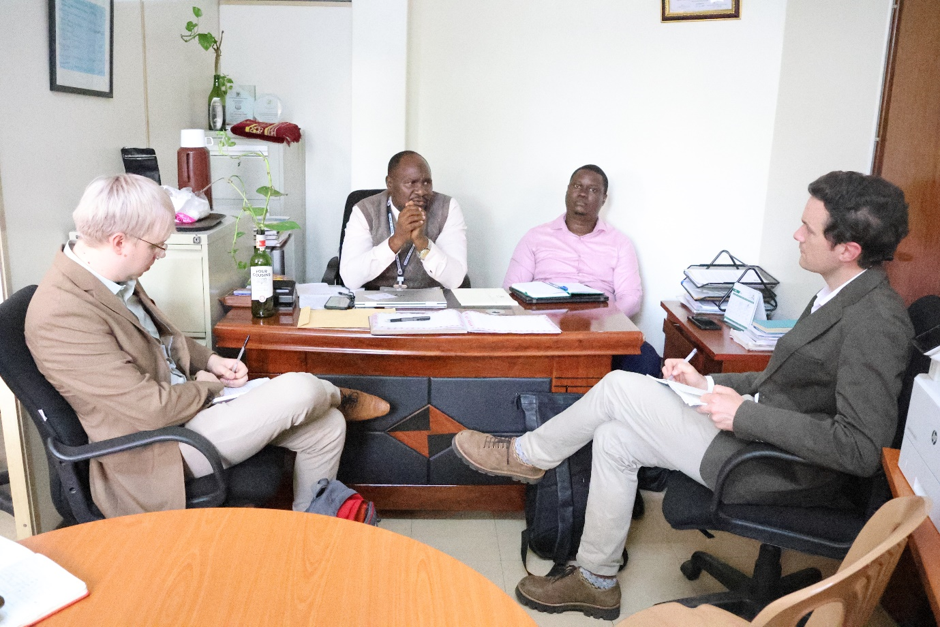
Dr. Muwanga meets Prof. Matthew at eye level during a discussion on innovation at the Ministry of Health. Beside Prof. Matthew is Dr. Will, while Jamiru, the Ministry’s IT personnel, sits next to Dr. Muwanga.
Dr. Moses Muwanga, the Commissioner of Palliative care at the Ministry of Health, has supported implementation, including site coordination and rollout.
“We recognised the need for systems that strengthen continuity of care and documentation,” he said. “The pilot has provided important learning on how digital approaches can support frontline workers and improve visibility of patient needs.”
But he also emphasized the importance of real-world grounding.
“These tools must respond to the realities of our health system,” he said. “Field experience will shape how this evolves.”
Part of what makes Uganda’s experience significant is the context in which it is unfolding. The pilot has operated in settings marked by staffing constraints, inconsistent connectivity, limited infrastructure, and complex care pathways. It is also contributing to broader global debates about how digital health functions outside controlled research environments.
“mPallCare is helping strengthen the evidence base by operating in underrepresented settings,” Allsop said.
Similar work in Malawi and Nepal is expanding this evidence further.
For Allsop, the central lesson is that pilots are not the endpoint.
“So many digital health tools stop at pilot stage,” he said. “They show promise, but do not become embedded in routine care.”
Over the past year, work has focused on transition to scale and sustainability.
“Implementation is messy,” he said. “As with all interventions, health systems change, staff move, policies shift, and priorities compete.”
This has required aligning the tool with clinical workflows rather than adding new burdens.
“If it creates extra work without value, it will not be used,” he said.
The platform is being refined through collaboration between clinicians, researchers, APCA, policymakers, and technology partners, including MRT IT Peaks Ltd. But Allsop cautions against replication without adaptation.
“The principles may travel,” he said. “But implementation must always fit local systems, policy environments, and patient needs.”
He also argues that future research must go beyond technical performance.
“We need to understand sustainability, integration, and real-world use over time,” he said.
Equally important is how digital systems interact with national health information systems and how continuity of care can be strengthened across levels of the system. But he returns repeatedly to lived experience.
“That means listening closely to patients and families, and ensuring tools reflect real needs rather than assumed ones,” he said.
During field discussions, those realities were unavoidable. Stories of interrupted care, long travel distances, and emotional strain shaped nearly every conversation.
“These experiences are shaped not only by illness, but also by uncertainty, separation, and access barriers,” he reflected.
Future research, he argues, must combine technical, clinical, implementation, and qualitative approaches.
“We need to know whether these tools are usable, acceptable, safe, equitable, and sustainable,” he said. “But also whether they actually improve care and preserve dignity.”
Throughout the visit, he returned to one final point: none of this work exists in isolation.
“This stands on the work of many pioneers in African palliative care,” he said, naming Dr. Anne Merriman, Dr. Eve Namisango, Dr. Mhoira Leng, Dr. Zipporah Ali, and others.
“What they have built through persistence and innovation shows that change is possible, even in difficult settings.”
As Uganda continues to test what digital palliative care can look like in practice, questions of scale, sustainability, and integration remain unresolved. But across clinics and communities, the work is already underway. And increasingly, systems like mPallCare are becoming part of an effort to ensure that people with advanced illness are not left unseen.
Look out for Part Two of this series coming soon.


